No Holds Barred (1989): When Steroids, Ego, and Cinema Enter a Steel Cage
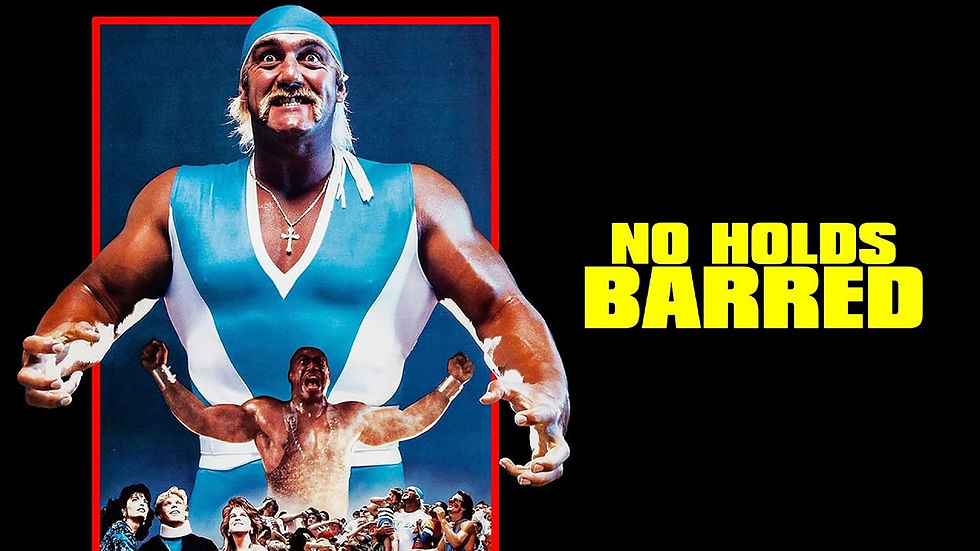
No Holds Barred is not a movie so much as it is a 90-minute tantrum thrown by the concept of subtlety. Starring Hulk Hogan as Rip—yes, just Rip, because last names are for cowards—it’s a film that feels like it was written on a gym mirror using protein powder and pure spite.
This is the kind of movie you don’t watch so much as survive. And I mean that lovingly.
Section 1 – A Brief History of Hulk Hogan (Up to 1989)

By 1989, Hulk Hogan wasn’t just a wrestler—he was a walking action figure.
Hulkamania had already steamrolled pop culture, fueled by neon tank tops, leg drops, and promos delivered at a volume normally reserved for jet engines. He had conquered wrestling, cartoons, lunchboxes, and questionable workout philosophies. Hollywood, seeing nothing but dollar signs and biceps with their own zip codes, naturally assumed this meant movie star.
Hogan had already dipped a toe into acting, but No Holds Barred was designed as his cinematic coronation—a film meant to prove that Hulk Hogan wasn’t just playing a hero in the ring, but could do it on the big screen, too. The result? A movie that feels less like a debut and more like a contractual obligation carved into stone tablets.
Section 2 – Production of the Film
The production of No Holds Barred feels less like a traditional movie shoot and more like a corporate synergy experiment conducted with reckless optimism.
At the time, professional wrestling was exploding in mainstream popularity, and there was a genuine belief—bordering on faith—that its biggest star could seamlessly leap into Hollywood. This film wasn’t conceived as a story that needed Hulk Hogan; it was conceived as a Hulk Hogan vehicle that needed a story, and that distinction matters. A lot.
The script was reportedly tailored to protect Hogan’s on-screen image at all costs. Rip is never wrong, never morally compromised, never truly challenged. Any obstacle exists solely so it can be crushed—physically, verbally, or ideologically—by Hogan’s biceps and booming voice. This isn’t character development; it’s brand management.
Creative Priorities (In Order)
Make Hulk Hogan look invincible
Make Hulk Hogan look righteous
Make Hulk Hogan look cool
Everything else
The production design reflects this hierarchy. Sets are sparse and utilitarian, often resembling TV soundstages rather than lived-in environments. Wrestling arenas look cheaper than real wrestling arenas, which is an impressive feat. Offices, apartments, and backrooms exist only long enough to stage confrontations or speeches before the movie barrels onward.
Casting and Performances
Supporting actors are clearly instructed—implicitly or otherwise—to operate in extremes. Villains are very villainous. Allies are unquestioningly loyal. No one is allowed to exist in a gray area, because gray might distract from the central glow of Rip.
The casting of Zeus is particularly telling. He isn’t chosen for nuance or charisma but for sheer physical presence. His role is to look terrifying, move slowly, and radiate menace like a sentient obstacle. Dialogue is optional. Staring is mandatory.
Budget Constraints and Shortcuts
The budget is modest, and the film does little to disguise it. Costumes repeat. Locations are reused. Action scenes are staged to minimize risk, effort, and expense. Instead of spectacle, the movie leans on volume—loud music, loud acting, loud editing—to simulate importance.
There’s also a sense that the production assumes its audience won’t question anything too closely. Logic gaps aren’t bridged; they’re jumped over with confidence. If something doesn’t make sense, the movie simply moves on, trusting that enthusiasm will carry the moment.
Overall Production Vibe
The dominant feeling behind the scenes seems to have been:
“People already like Hulk Hogan. This just needs to exist.”
And to be fair, that confidence does come through on screen—just not always in the way intended. The result is a film that feels aggressively self-assured despite lacking polish, restraint, or cinematic discipline. It’s a movie made by people who never stopped to ask whether it should work, because they were convinced it would.
That unwavering belief—misguided as it is—becomes part of the film’s strange charm.
Section 3 – In-Depth Review of the Story / Plot
The story of No Holds Barred is less a narrative and more a series of moral victories strung together with flexing. It technically has a beginning, middle, and end, but those are mostly excuses to move Rip from one righteous confrontation to the next.
The Hero: Rip (Because Last Names Are Optional)
Rip is introduced as the most beloved wrestler on Earth. Crowds adore him. Kids worship him. Authority figures respect him. The movie establishes, within minutes, that Rip is:
The strongest
The most principled
The most loyal
The most correct in every situation
There is no “before” Rip and no “after” Rip. He begins the movie complete. This is important, because it means the plot cannot challenge him in any meaningful way—only delay his inevitable victory.
The Conflict: Capitalism, But Like… Mean Capitalism
The villain is an evil television network owner whose motivation appears to be owning Rip the way one owns a sports car. He doesn’t want Rip for money so much as dominance. Contracts are waved around like weapons. Lawyers exist purely as threats.
When Rip refuses to sell his soul—because he has values, brother—the villain escalates in the most logical way possible: by creating an entire underground wrestling league designed solely to spite him.
This is not subtext. It is text. Loud text.
Enter Zeus: The Human Plot Device
Zeus is less a character and more a walking inevitability. He exists to loom, to glare, and to remind the audience that the final fight will be “brutal,” despite looking exactly as staged as everything else.
Zeus doesn’t grow. He doesn’t change. He is deployed by the plot whenever Rip needs a physical obstacle instead of a philosophical one. His presence signals danger, but never doubt—because the movie never allows the possibility that Rip might actually lose.
Escalation Without Consequences
The plot attempts to raise stakes through kidnapping, threats, and illegal wrestling matches, but none of it ever sticks. Rip reacts to danger with mild annoyance and louder speeches. Emotional beats are introduced and resolved so quickly they barely register.
Characters make dramatic decisions, only for the movie to immediately reassure you that:
Rip is still right
Rip is still winning
Everything will work out because Rip exists
The story doesn’t unfold—it marches, powered by certainty instead of tension.
The Climax: Inevitable, Loud, and Proud
The final confrontation is framed as a no-rules, no-limits showdown, but it feels more like the movie checking off a requirement. Trash cans, chains, slow-motion punches—it’s all there, but none of it surprises.
You know how it ends because the movie has told you from the beginning how it ends. Rip wins. Justice prevails. Muscles are validated.
Why the Plot Fails (and Accidentally Succeeds)
As storytelling, the plot is deeply flawed:
No character arcs
No real obstacles
No emotional uncertainty
But as a power fantasy frozen in 1989, it’s fascinating. The movie doesn’t want to explore conflict; it wants to reassure its audience that their hero is unstoppable, morally pure, and louder than anyone else in the room.
It’s not a story designed to engage—it’s a story designed to affirm. And while that makes it dramatically hollow, it also makes it unintentionally hilarious. The plot’s refusal to acknowledge complexity turns the entire film into a straight-faced parody of heroic storytelling.
You don’t follow the story so much as you watch it flex at you, daring you to disagree.
Section 4 – Editing and Cinematography
The editing and cinematography of No Holds Barred feel like they were designed with a single, unwavering philosophy: never let the audience sit with anything for too long—especially logic.
Editing: Momentum Over Meaning
The editing is aggressive in a way that suggests fear—fear that if a scene lasts more than a few seconds, viewers might notice how little is actually happening. Cuts come fast and often without rhythm. Conversations don’t breathe; they simply end. Reactions are occasionally mismatched, as if the editor was assembling the film based on vibes rather than continuity.
Action scenes are chopped into rapid fragments that paradoxically make them feel slower. Punches don’t land so much as pass through the edit, assisted by quick cuts and loud sound effects. It’s less about clarity and more about creating the illusion of impact.
There’s also a noticeable habit of cutting away just as something might become interesting. Emotional tension? Cut. Awkward pause? Cut. Potential character moment? Absolutely not—cut immediately.
Cinematography: Functional to a Fault
Visually, the film operates at the bare minimum required to be called cinema. The camera is rarely expressive; it’s positioned to observe, not interpret. Shots are framed to ensure Hogan is centered, dominant, and well-lit—often at the expense of everyone else in the scene.
Lighting is flat and utilitarian, giving many interiors the look of a television studio rather than a film set. Shadows are scarce. Mood is nonexistent. Everything is evenly lit so you can clearly see:
Who the hero is
Who the villain is
Who is about to be yelled at
There’s little variation in shot composition. Close-ups are reserved almost exclusively for scowls and declarations. Wide shots exist mainly to confirm that yes, a fight is happening in a space large enough to contain it.
Action Coverage: Safety First, Cinema Second
Fight scenes are staged conservatively, with camera angles that protect the performers more than they excite the audience. Impacts are suggested, not shown. The camera often cuts away at the exact moment a blow should connect, relying on sound effects and editing to sell the hit.
Slow motion is deployed sparingly but always dramatically, as if to underline moments the movie desperately wants you to feel are epic. Whether they actually are is beside the point.
Overall Visual Identity
There is no strong visual style, no thematic use of color, no cinematic personality beyond competence. The film doesn’t look bad so much as it looks indifferent. It’s imagery designed to document rather than elevate, serving the story’s simplest needs without adding anything of its own.
In a strange way, this blandness contributes to the movie’s charm. The lack of artistry makes every over-the-top performance and ridiculous plot beat stand out even more. The film isn’t trying to dazzle—it’s trying to get through the scene so it can move on to the next flex, shout, or slow-motion punch.
And in that sense, the editing and cinematography are perfectly aligned with the movie’s soul: loud, hurried, and unconcerned with refinement.
Section 5 – Music
The music in No Holds Barred operates under the firm belief that silence is the enemy and that every single moment—no matter how trivial—deserves to feel like the climax of a pay-per-view event.
A Score With One Emotion: “IMPORTANT”
The soundtrack doesn’t respond to what’s happening on screen; it dictates how you’re supposed to feel, loudly and repeatedly. The score is dominated by booming synths, pounding percussion, and heroic stings that seem permanently set to maximum confidence.
Subtlety is not merely absent—it’s actively avoided. The music doesn’t build tension or underscore drama; it arrives fully formed and refuses to leave. Whether Rip is:
Walking into a room
Standing silently
Thinking about standing silently
…the music insists that this is a Big Deal™.
Wrestling Energy, Movie Length
Much like professional wrestling entrance themes, the score is designed to hype rather than support. It feels like background music for a highlight reel stretched to feature length. There’s a constant sense that the soundtrack is waiting for a crowd reaction that never comes.
In quieter scenes—if they can even be called that—the music continues at nearly the same intensity, flattening any emotional dynamics the story might attempt. Kidnappings sound heroic. Confrontations sound triumphant. Menacing villains sound like they’re about to win a championship belt.
Timing and Tone Disconnect
One of the most unintentionally funny aspects of the score is how often it completely misreads the room. Moments that should feel threatening are underscored with confidence. Scenes meant to be tense come off as motivational. Emotional beats are drowned in synths that suggest victory is not only assured, but already celebrated.
The music never allows doubt, which mirrors the film’s broader philosophy: nothing bad is ever really going to happen, so why pretend otherwise?
Memorability (Or Lack Thereof)
Ironically, despite how loud and omnipresent it is, the score is largely forgettable. There are no distinct themes, no melodies that stick—just a general wash of late-’80s bravado. It’s less a soundtrack and more a continuous audio flex.
And yet, that very excess becomes part of the charm. The music’s refusal to dial it back adds to the film’s absurdity. It doesn’t elevate scenes so much as inflate them, turning even mundane actions into faux-epic moments.
Why It Works (Accidentally)
As a serious film score, it’s exhausting and misguided. But as part of No Holds Barred’s overall personality, it fits perfectly. The music embodies the same mindset as the script and performances: louder equals better, confidence equals quality, and restraint equals weakness.
It’s not good music—but it’s very on-brand music, and by the end, it feels less like a flaw and more like another exaggerated muscle the movie can’t stop flexing.
Section 6 – Light-Hearted Review: Making Fun of It While Enjoying Every Minute
This is the section where No Holds Barred stops pretending to be a serious movie and becomes what it was always destined to be: an unintentional comedy masterpiece.
Everything about the film is played completely straight, which is precisely why it’s so funny. The characters don’t wink. The script doesn’t acknowledge its own absurdity. The movie looks you dead in the eye, flexes, and demands respect—and that confidence transforms every misstep into gold.
Dialogue That Deserves Applause (For Existing)
The dialogue is delivered like every line is a wrestling promo cut at the wrong time. Nobody talks like a human being. People announce their feelings. Threats are spelled out. Moral lessons are shouted.
Hogan’s delivery, in particular, feels like he’s arguing with the concept of acting itself. Lines are barked, not spoken. Pauses feel designed for crowd reactions that exist only in his mind. It’s mesmerizing.
You don’t quote this movie because the lines are clever—you quote them because they sound like they were assembled by accident.
Performances Cranked to Eleven
Villains sneer. Allies nod approvingly. Zeus stares like he’s loading a new emotion but never quite finishes. Everyone is performing at maximum intensity regardless of the situation.
There is no tonal variation. A casual conversation and a violent confrontation are treated with the same level of dramatic urgency. It’s exhausting, but in the way that makes you laugh because the movie clearly has no idea how funny it’s being.
Action That’s Big, Fake, and Glorious
The fights are stiff, slow, and staged with the care of people who absolutely do not want to get hurt—and that’s part of the charm. Trash cans are introduced with reverence. Chains appear as if summoned. Punches miss by a mile, but the sound effects insist otherwise.
Slow motion is used like punctuation: “This moment matters,” the movie says, even when it absolutely doesn’t.
The Joy of Watching With an Audience
This is not a movie you watch quietly. It demands commentary. It thrives on laughter, disbelief, and group reactions. Someone will pause it. Someone will rewind. Someone will ask, “Why is this happening?” and no one will have an answer.
And that’s the joy of it.
Why the Cheese Works
No Holds Barred is funny because it’s sincere. It genuinely believes it’s telling an epic story about honor, strength, and righteousness. That sincerity, combined with its limitations, turns every scene into something ridiculous and delightful.
You laugh at it, not with it—but you laugh because it never once tries to earn the joke. The humor emerges naturally from excess, ego, and complete lack of self-awareness.
It’s cinematic junk food: terrible for you, impossible to stop consuming, and weirdly satisfying long after it’s over.
Section 7 – A More Serious Review: Where It Actually Falls Apart
Once the laughter fades and the novelty wears thin, No Holds Barred reveals just how fundamentally broken it is as a piece of filmmaking. Enjoyment aside, this is a movie that collapses under even the gentlest critical pressure.
A Story Without Conflict
The most significant flaw is the complete absence of real stakes. Rip is never meaningfully challenged—physically, emotionally, or morally. From the opening scene, the film assures you that he is correct, unstoppable, and destined to win.
Without the possibility of failure, tension evaporates. Every threat becomes noise. Every obstacle feels like filler. A protagonist who cannot lose makes for a story that cannot surprise.
Characters as Functions, Not People
No character exists beyond their relationship to Rip. Allies exist to praise him. Villains exist to oppose him. Love interests exist to be imperiled. No one has inner conflict, complexity, or autonomy.
Even the antagonist’s motivations are shallow. His obsession with Rip isn’t grounded in believable psychology or ambition—it’s just exaggerated spite. Zeus, meanwhile, is pure spectacle without substance, a visual threat that never evolves into a dramatic one.
Performance Limitations
Hulk Hogan’s screen presence is undeniable, but presence is not acting. He delivers every line at the same volume and emotional register, leaving no room for nuance. When every moment is emphasized, none of them stand out.
The supporting cast fares little better, constrained by a script that demands exaggeration rather than authenticity. There’s no room for naturalism, and the result is a film that feels artificial even when it’s trying to be sincere.
Technical Mediocrity
On a technical level, the film is serviceable at best. The editing is choppy, the cinematography uninspired, and the music overbearing. None of these elements actively enhance the story; they merely exist to push it forward.
There’s no visual storytelling, no thematic coherence, and no artistic ambition beyond getting from one scene to the next.
The Core Problem: Ego Over Craft
At its heart, No Holds Barred confuses image preservation with storytelling. The movie is designed to protect a brand, not explore a character or tell a compelling story. Every creative decision bends toward reinforcing Hogan’s heroic image, even when it undermines drama.
That makes the film hollow. Entertaining, yes—but hollow.
Why It Matters
As a serious film, No Holds Barred fails because it doesn’t understand what movies do best: create empathy, tension, and transformation. It offers certainty instead of growth, noise instead of depth, and confidence instead of craft.
It’s a fascinating misfire—one that accidentally succeeds as entertainment while failing almost completely as cinema.
Outro – Final Thoughts and Ratings
In the end, No Holds Barred stands as a perfect artifact of its time: loud, overconfident, deeply unserious, and completely convinced of its own greatness. It’s a movie built on the belief that charisma can replace craft and that sheer volume can overwhelm criticism.
And somehow—against all odds—that belief half works.
As cinema, it’s clumsy, shallow, and technically uninspired. It lacks tension, nuance, and narrative discipline. It is not well-written, well-acted, or well-directed. If judged strictly as a film, it collapses almost immediately.
But as an experience? It’s fantastic.
This is a movie you watch with friends, with commentary, with laughter. A movie that dares you to take it seriously and becomes infinitely better the moment you refuse. Its sincerity turns its flaws into punchlines, and its excess transforms failure into entertainment.
It’s not good—but it’s fun. And sometimes, that’s enough.
🎉 Enjoyment Rating: 8/10
🎬 Actual Movie Rating: 3/10
A cinematic leg drop straight onto good taste—followed by a confident pose and absolutely no regrets. 💪


Comments