WCW Monday Nitro – September 4, 1995: The Night the War Began

Prologue: Before the Pyro — The State of Wrestling in 1995
Professional wrestling in 1995 stood at an uneasy crossroads. The World Wrestling Federation (WWF) was still the household name, but its product had softened — a swirl of cartoonish gimmicks, family-friendly lighting, and declining ratings. Meanwhile, in Atlanta, Georgia, Ted Turner’s cable empire quietly kept alive a rival: World Championship Wrestling (WCW).

WCW’s roots stretched back to the Jim Crockett Promotions of the 1970s and early ’80s — the bedrock of Southern wrestling. Turner had purchased the struggling territory in 1988 to secure wrestling content for his TBS network. In the early 1990s, WCW floundered under committee-style booking and inconsistent creative direction. It was viewed as a “southern” product — more athletic than showbiz, but lacking WWF’s spectacle.
Then came a seismic hire: Hulk Hogan.

When the red-and-yellow icon jumped ship in 1994, the wrestling world gasped. Hogan brought with him WWF’s mainstream aura, a carnival of celebrity friends, and a craving for bright lights. WCW suddenly had not only Ric Flair, Sting, and a deep technical roster — it had the face of 1980s pop-culture wrestling.
Enter Eric Bischoff, WCW’s young executive producer. Bischoff convinced Ted Turner that the company needed live, prime-time TV on Monday nights to compete head-to-head with WWF’s Monday Night Raw. Turner asked, “What do you need to beat Vince?” Bischoff answered, “Give me prime time on TNT.” The rest became wrestling television history.
Thus, the debut of WCW Monday Nitro on September 4, 1995, broadcast live from the Mall of America in Bloomington, Minnesota, wasn’t merely a new program. It was the launch of a cultural arms race — what fans would later call The Monday Night War.

The Opening Bell — A Show Unlike Any Other
The camera swept across escalators, storefronts, and balconies of the bustling Mall of America. Shoppers craned for a view of the squared circle nestled beneath a skylight atrium. The visual screamed difference — not the dim, generic arenas of syndicated wrestling, but something new and unpredictable.
At the announce desk:
Eric Bischoff, young and sharp, doubling as executive and on-air host.
Bobby “The Brain” Heenan, freshly defected from WWF, a master of wit and villainy behind the headset.
Steve “Mongo” McMichael, a former NFL linebacker new to commentary, adding mainstream-sports bravado.
Their banter was rough around the edges but lively. Heenan smirked that the mall was an appropriate venue — after all, fans could “shop for a clue.” Bischoff fired back, establishing that WCW was not only live but ready to talk back.
And so it began.
Match 1: Brian Pillman vs Jushin “Thunder” Liger

(Opening contest – 8 minutes of athletic mayhem)
The first match in Nitro history perfectly encapsulated WCW’s ambition to present variety and athleticism.
Brian Pillman, once a Cincinnati Bengal turned aerial daredevil, had carved his reputation in WCW’s light-heavyweight division. Charismatic and fiery, he bridged two worlds: the muscular American style and the faster Japanese influence.
His opponent, Jushin “Thunder” Liger, already a legend in Japan’s New Japan Pro Wrestling, was recognized worldwide as a pioneer of the junior-heavyweight style — combining martial-arts grace with comic-book flamboyance. His mask and costume glowed red and silver under the mall lights.
From the opening lock-up, the two exchanged crisp holds and dazzling reversals. Pillman dropkicked Liger through the ropes, and the crowd popped — a roar echoing off glass balconies. Liger retaliated with a top-rope moonsault to the floor, earning gasps even from casual shoppers leaning over railings.
What made this opener so important was not just its pace but its statement: WCW would showcase wrestling from around the world. This was athletic competition, not cartoon spectacle.
The match climaxed in a frenetic finishing stretch. Pillman countered a superplex, slipped free, and launched a flying cross-body for the pin. The referee’s hand hit three, and Pillman’s victory sent a shock of adrenaline through the crowd.
Historical Note: That one match quietly signaled WCW’s next great innovation — the cruiserweight division — which would flourish in later Nitros with Rey Mysterio Jr., Eddie Guerrero, and Chris Jericho.
Backstage & Banter: Setting the Tone
Between matches, Bischoff hyped WCW’s larger-than-life roster and upcoming pay-per-view, Fall Brawl ’95: War Games. Cutaway promos featured Hulk Hogan in full red-and-yellow glory plugging “Pastamania,” his real-life restaurant inside the same mall. It was shameless synergy — and utterly on-brand for mid-’90s Hogan.

Match 2: Sting (c) vs Ric Flair — United States Championship

Two men who defined WCW.
Sting, the blonde-painted franchise of the company, had grown from surfer-cool babyface to heroic standard-bearer. Athletic, charismatic, and beloved, he embodied the idea that WCW could make its own stars.
Ric Flair, “The Nature Boy,” needed no introduction. Sixteen world titles, a symphony of arrogance, and a presence that commanded reverence. In many ways, this match was symbolic: the past and the future of WCW colliding before a live national audience.
As the bell rang, the crowd’s energy peaked. Flair strutted and taunted; Sting flexed and roared. They traded holds — Flair’s chain wrestling against Sting’s power. When Sting gorilla-pressed Flair over his head, shoppers on the second level erupted.
Mid-match, an unexpected stir: Lex Luger appeared in the aisle. Broad-shouldered, freshly visible on WWF television days earlier, his presence shocked both the live crowd and viewers at home. Bischoff, live on commentary, feigned disbelief: “What’s he doing here?”
That was Nitro’s first great live shock. Luger’s silent stare toward the ring while security approached him injected pure chaos into what had been a classic title match. For the first time, fans realized Nitro could — and would — break the industry’s rules of predictability.
The match itself ended in a schmoz (a double disqualification after interference by Arn Anderson), keeping both men strong while fueling the Flair/Anderson breakup angle heading toward Fall Brawl.
Post-match commentary kept replaying Luger’s appearance, teasing questions with no answers. In 1995, that kind of real-time uncertainty was revolutionary.
Segment: The Lex Luger Shock
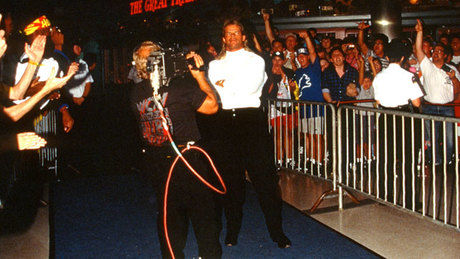
Luger was escorted backstage for an impromptu interview. His expression: composed but cocky. He declared, “I’m tired of playing with kids — I’m here to play with the big boys.”
Those words became Nitro’s calling card. Within hours, WWF management learned of his defection on television. It was the first public roster jump of the modern TV era and established WCW as a legitimate threat.
Luger’s arrival foreshadowed the open-door, “outsider” feeling that would later culminate in the nWo invasion angle a year later.
Match 3 (Main Event): Hulk Hogan (c) vs Big Bubba Rogers — WCW World Heavyweight Title

By this point, the crowd was primed for spectacle. Hogan, the World Champion, marched to the ring accompanied by the roar of “Real American”-esque music (WCW’s legally distinct version). His red-and-yellow charisma filled the atrium.
Big Bubba Rogers, the former “Big Boss Man” from WWF, was a big, tough veteran brawler. WCW used him here as a credible foil — a big man who could bump and make Hogan look heroic.
The match itself was textbook Hogan: early power exchanges, Bubba dominating with heavy shots, a bearhug sequence, and Hogan’s signature comeback — finger wag, big boot, and leg drop. One-two-three. Hogan retained the title.
What followed, however, was pure Nitro chaos. The Dungeon of Doom, Hogan’s gallery of cartoonish monsters, hit the ring to attack. Suddenly, Lex Luger stormed out again — this time to help Hogan clear the ring. The crowd screamed as the two posed together, muscles gleaming under the mall’s spotlights.
Bischoff sold it on commentary: “Luger’s here, Hogan’s here — what does this mean for WCW?”
Backstage afterward, Hogan and Luger confronted each other in a tense promo. Luger wanted a title shot. Hogan agreed — next week, live on Nitro. It was an audacious promise: world title matches on free TV.
That cliffhanger sealed Nitro’s identity: spontaneous, live, and high-stakes.

Interludes & Promos: Building a Universe
Throughout the episode, WCW sprinkled in brief promos and video packages:
A vignette for Michael “Wallstreet” Rotunda, hinting at a new money-obsessed heel gimmick parodying WWF’s “Million Dollar Man.”
Teasers for Sabu’s debut, signaling WCW’s willingness to import unpredictable, hardcore-style talent.
A promotional segment for Fall Brawl’s War Games match between Hogan’s team and the Dungeon of Doom.
Each bit served a dual function: expand Nitro’s weekly world and plant hooks for future pay-per-views.
Deep Wrestler Bios — The Faces of the War
Hulk Hogan
The man whose fame transcended wrestling. By 1995, Hogan’s WWF glory had cooled, but his jump to WCW revitalized both parties. Hogan’s creative control and larger-than-life persona dominated WCW’s storytelling for the next two years — until the nWo heel turn in mid-1996 redefined him as “Hollywood Hogan.” This debut episode displayed his control and star power; it also hinted at creative stagnation that would soon require reinvention.
Ric Flair
Already a multi-time world champion, Flair was WCW’s aristocrat of excellence. His psychology and promo work kept WCW’s product grounded in wrestling tradition even as the company pursued flashier TV. His feuds with Sting, Hogan, and later the nWo would bridge eras, ensuring lineage amidst revolution.
Sting
The perennial hero, beloved and loyal. Sting’s WCW loyalty made him the company’s moral center. On Nitro’s debut, he represented hope — the pure athlete who could fight veterans like Flair and newcomers like Luger. Over the next two years, he would transform into the silent “Crow” vigilante, becoming the heart of WCW’s most iconic storyline.
Lex Luger
The wildcard. Once a rising star in both NWA and WWF, Luger’s unexpected return symbolized Nitro’s unpredictability. Though often criticized for stiffness, his physical charisma and crossover familiarity gave WCW a valuable pawn in the coming ratings war. His “I’m here to play with the big boys” line encapsulated Nitro’s defiant tone.
Brian Pillman
A technical marvel and future innovator. In 1995, Pillman was still the fiery babyface; within a year, he’d revolutionize the industry with his “Loose Cannon” persona — blurring fiction and reality. His Nitro opener with Liger showcased the athletic direction WCW would later refine into its cruiserweight division.
Jushin “Thunder” Liger
International pioneer and NJPW superstar. His presence on an American live debut connected WCW to Japan’s global scene and forecasted the cross-promotional landscape of modern wrestling. Though his Nitro appearances were limited, his influence was monumental in legitimizing lighter-weight, high-flying wrestling in the U.S.
Aftermath and Trajectory: What Nitro Built Toward
Short-Term (Fall 1995 – Early 1996)
Nitro expanded to two hours of live TV, allowing longer storylines and deeper rosters.
The Hogan vs. Dungeon of Doom feud dominated the next months, peaking at Halloween Havoc ’95 and World War 3.
Luger turned tweener, aligning with Sting but feuding with Hogan, teasing internal WCW fractures.
The show quickly began beating WWF’s Raw in key demographics — a turning point that would culminate in 1996’s ratings surge.
Medium-Term (1996 – 1998): The nWo Era
Everything Nitro did on its first night — surprise appearances, live realism, breaking kayfabe boundaries — laid groundwork for the New World Order storyline.
In May 1996, Scott Hall (Razor Ramon in WWF) appeared live on Nitro, walking through the crowd — echoing Luger’s shocking debut. Then came Kevin Nash, and finally Hogan’s legendary heel turn at Bash at the Beach ’96.
From 1996–1998, WCW dominated ratings, largely due to Nitro’s format born on that debut night: live, cinematic, star-driven chaos.
Production, Style, and Legacy
The Mall of America setting was both a marketing stunt and a visual metaphor: wrestling invading mainstream America’s everyday spaces. Nitro’s live presentation, multi-camera chaos, and mix of athletes and icons became the template for modern sports-entertainment television.
Commentary chemistry improved as the weeks went on, but the debut already established WCW’s voice: irreverent, bold, willing to name its rival company on-air — a forbidden act in earlier eras.
Critical Reception and Long-Term Appraisal
Contemporary critics in 1995 were cautiously impressed. Some dismissed it as another flashy WCW gamble; others recognized the potential. Looking back, wrestling historians now view the Nitro premiere as a turning point on par with WrestleMania I — the moment wrestling realized it could reinvent itself live every Monday night.
In hindsight:
Cultural Impact: 10/10
Historical Importance: 10/10
In-Ring Quality: 7.5/10 (Liger vs Pillman aged remarkably well)
Storytelling Vision: 9/10 — it understood live television drama before wrestling fully embraced it.
Epilogue: The Spark that Lit the War
When Nitro signed off that night, fans had witnessed three things that defined the next decade of wrestling television:
Live unpredictability (Lex Luger’s return)
Global athleticism (Pillman vs Liger)
Star spectacle (Hogan’s main-event dominance)
WCW didn’t just debut a TV show; it detonated a cultural time bomb. From that mall in Minnesota, the wrestling industry would never again be the same. Every swerve, every shocking debut, every live cliffhanger in wrestling today traces back to the moment Bischoff smirked into the camera and said, “We’re live!”
Bibliography & Sources
Primary Sources
WCW Monday Nitro – Episode 1, TNT broadcast, September 4, 1995. Turner Broadcasting System.
WCW Saturday Night (1994–1995 episodes), TBS Network Archives.
Fall Brawl ’95: War Games, WCW Pay-Per-View, September 17, 1995.
Hogan, Hulk. Hulk Hogan: My Life Outside the Ring. New York: St. Martin’s Press, 2009.
Bischoff, Eric. Controversy Creates Cash. New York: Gallery Books, 2006.
Flair, Ric with Keith Elliot Greenberg. To Be the Man. New York: Pocket Books, 2004.
Secondary Sources
Meltzer, Dave. Wrestling Observer Newsletter, September 11, 1995 edition — “Nitro Debut Review.”
Shoemaker, David. The Squared Circle: Life, Death, and Professional Wrestling. New York: Penguin Books, 2013.
Hornbaker, Tim. Death of the Territories: Expansion, Betrayal and the War That Changed Pro Wrestling Forever. ECW Press, 2018.
Oliver, Greg, and Johnson, Steve. The Pro Wrestling Hall of Fame: The Heels. Toronto: ECW Press, 2007.
The Monday Night War documentary series. WWE Network, 2014. Episode 1: “The War Begins.”
Lavie, Evan. “The First Nitro: Looking Back at WCW’s Revolutionary Debut.” Pro Wrestling Torch, September 2015.
Shoemaker, David. “When Wrestling Went to War: The Night Nitro Changed Everything.” Grantland, August 2013 (archived).
Supplemental Interviews and Historical Context
Eric Bischoff interview, 83 Weeks Podcast, Episode 1: “The First Nitro,” MLW Radio Network, 2018.
Tony Schiavone, What Happened When Podcast, “Nitro Debut” episode, 2017.
Brian Pillman Jr. interview, Talk is Jericho, Episode 313: “The Legacy of the Loose Cannon,” 2020.
The Rise and Fall of WCW documentary, WWE Home Video, 2009.


Comments